Reviewed and updated August 29, 2026 by the binom.courses editorial team · how we test
Search for “affiliate tracker” and you will get results from four distinct product categories that share a word and almost nothing else. People buy the wrong one regularly, spend a month fighting it, and conclude the category does not work.
This page sorts them out, then points to the deeper comparison for whichever one you actually need.
The four categories
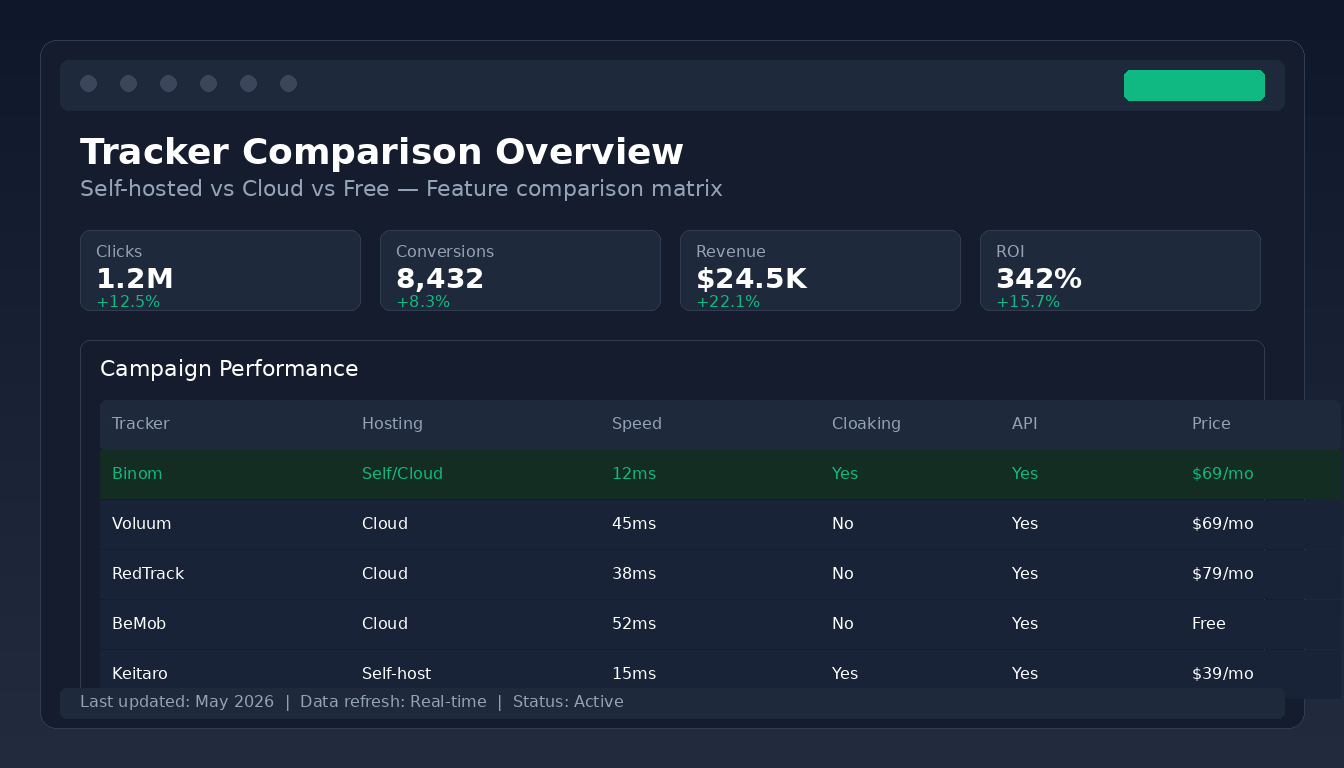
| Category | What it is for | Priced by | Examples |
|---|---|---|---|
| Self-hosted tracker | Media buying at volume, on your own server | Flat licence | Binom, Keitaro, CPV Lab Pro |
| Cloud tracker | Media buying without operations | Events or visitors | Voluum, RedTrack, BeMob, FunnelFlux Pro |
| Link tracker | Affiliates promoting via email, organic and bio links | Visitors | ClickMagick and similar |
| Network platform | Running an affiliate programme and paying partners | Partners or revenue | Affise and similar |
The first two are what this site is about. The third overlaps at the small end. The fourth is on the other side of the postback entirely — we cover that mix-up in Binom vs Affise because it is one of the most-searched confusions in the category.
The decision tree
Do you pay a platform for clicks or impressions?
If no — you are paid commissions rather than paying for traffic — you may want a link tracker or, if you run a programme, network platform software. Neither is what the rest of this site compares.
Is your monthly volume above roughly two million events?
If no, a cloud tracker is almost certainly correct: cheaper at that size, and the operations you avoid are worth more than the price difference. Start at best tracker for beginners.
Can someone on your side keep a Linux server alive?
If no, stay on cloud, or take a managed licence like Binom Cloud at $299 a month. A self-hosted tracker that nobody can patch is an outage waiting for a busy day.
Do you have a hard requirement on data residency or retention?
If yes, self-hosted is the only category that can answer it, regardless of volume. You choose the jurisdiction and you own the disk.
Otherwise: run the volume arithmetic
Above ten million events a month the flat licence is several hundred dollars a month cheaper and the gap grows. The comparison hub has the table.
Where each category breaks down
Self-hosted: the 3am problem
Nobody else is responsible for uptime. Disk fills, certificates expire, kernels need patching. The cost is not money, it is attention, and people who claim self-hosting is cheaper usually forget to price theirs.
Cloud: the meter never stops
Metered pricing compounds. A campaign that unexpectedly does ten times its usual volume produces an invoice, not just a load question. Above 20M events this is a four-figure monthly difference.
Link trackers: volume ceilings
Priced per tracked visitor with published tiers topping out around a million a month. One mid-sized push campaign passes that in days.
Network platforms: no cost side
Built to attribute conversions to partners, not to break your ad spend down by creative and placement. Using one for media buying loses the entire reporting layer you needed.
Category errors are expensive but recoverable; the real cost is time. Before shortlisting anything, answer one question in writing: do I pay for traffic, or do I get paid for traffic? Everything else follows from that.
Read next, by situation
Self-hosted vs cloud
The main decision, with total cost of ownership worked through at four volumes.
Read →Free affiliate trackers
What is genuinely free, what the free tier costs you instead, and when it ends.
Read →Best tracker for beginners
Chosen on learning curve and recoverability, not on feature count.
Read →Tracker for media buyers
What changes when traffic becomes a budget line rather than a test.
Read →Tracker for agencies
Seats, client separation, white labelling and the reporting clients actually read.
Read →Compare eight trackers
Verified list prices and the volume where each one wins.
Read →A category that barely exists any more
Older guides list “standalone TDS” as a fifth type. In practice every serious tracker absorbed traffic-distribution functionality years ago, and running a separate router in front of your tracker adds a redirect hop for benefits most buyers do not need. We cover the exceptions in what is a TDS — they are real, but they are narrow.